
District releases updated SWIM Plans for 7 watersheds

HAVANA – The Northwest Florida Water Management District recently released its final Surface Water Improvement and Management plans for seven priority watersheds across the Florida Panhandle.

The SWIM plans were developed by the District to protect and restore watershed resources across northwest Florida. The plans help identify watershed needs and challenges and also help estimate funding needs and alternatives.

“These updated SWIM plans will help the District continue its mission of protecting the precious natural resources of northwest Florida,” said George Roberts, Chairman of the District’s Governing Board.

“Though District staff led development of these plans, our efforts were supported with feedback from state and federal agencies, local governments, non-governmental organizations, and private citizens. We are appreciative of all who helped review these plans and provided comments that helped us finalize our work. We especially appreciate the grant funding and support provided by the National Fish and Wildlife Foundation.”

The SWIM plans were developed for the following watersheds:

These comprise all of the major riverine and estuarine watersheds of northwest Florida.

“Florida’s iconic natural resources are the foundation of our economy and our way of life, and our diverse water resources are our hallmark” said DEP Secretary Noah Valenstein. “DEP is committed to continuing our partnership with Florida’s water management districts and local governments to identify and implement projects needed to protect and restore Florida’s springs, rivers, and waterways so these resources can be enjoyed for generations to come.”

The District’s SWIM plan updates were completed with grant funding assistance from the National Fish and Wildlife Foundation’s Gulf Environmental Benefit Fund (GEBF). Associated with this effort, the GEBF has also funded SWIM plan updates for the Suwannee River Water Management District, an evaluation of barriers to seagrass recovery in the Gulf of Mexico conducted by the Florida Fish and Wildlife Research Institute, and an overall GEBF restoration strategy being developed by the Florida Fish and Wildlife Conservation Commission in cooperation with numerous stakeholders.

The SWIM program is implemented by the District, working cooperatively with the Florida Department of Environmental Protection, other state and federal agencies, local governments, and private stakeholders to accomplish watershed protection and restoration objectives.

“The Nature Conservancy is extremely pleased with the updates to the District’s SWIM plans and would like to thank District staff for their tireless efforts to update the plans and incorporate community input,” said Darryl Boudreau, Watershed Coordinator at The Nature Conservancy. “This level of integration and cooperation between private and public entities to identify and solve the most important problems facing our watersheds is critical to ensuring that the limited funds available for environmental protection have the greatest impact on our Panhandle communities. This is the way TNC operates and we are proud to be part of this exciting process.”

Publicly noticed meetings took place at locations within each watershed to encourage public involvement in the SWIM plan process. Drafts of each SWIM plan were distributed for review and the District accepted comments on each plan before final publishing.

“While I didn’t have the opportunity to attend all of the District’s public meetings regarding the development of the multiple watershed SWIM plan updates, I did attend enough to see that many other citizens felt the same levels of concern and hope for the future of these waterways. And they spoke up and were heard,” said George Willson, a conservationist and former District Governing Board member. “I’d recommend these SWIM documents be included in school science programs for water resource study.”

The plans were developed under the Surface Water Improvement and Management (SWIM) Act enacted in 1987 by the Florida Legislature to improve and manage the water quality and natural systems of the state’s surface waters, which include lakes, rivers, streams, estuaries, springs, and wetlands.

The plans incorporate comprehensive strategies to both restore and to protect watershed resources. Implementation is accomplished through a variety of activities, such as retrofitting stormwater management systems to improve water quality and flood protection; restoring wetland and aquatic habitats; supporting enhanced wastewater management and treatment; evaluating resource conditions and freshwater needs; protecting and restoring springs; and providing public outreach and awareness.

The SWIM program also supports coordination of state and federal grants and implementation of cooperative projects with local governments.

To learn more about the updated SWIM plans, please visit https://nwfwp.sgssys.info/Water-Resources/SWIM
Nate update: District re-opens all recreation sites

The District has re-opened all of its recreation sites that were closed after Hurricane Nate.

Day-use and overnight camping is now open at all sites within the Escambia River, Perdido River, Yellow River, Garcon Point, and Blackwater River Water Management Areas.

District releases draft SWIM plans for Apalachicola, St. Andrew bays

The Northwest Florida Water Management District has released its draft Surface Water Improvement and Management (SWIM) plans for the Apalachicola River and Bay and St. Andrew Bay watersheds. These draft plans were prepared in accordance with section 373.453, F.S., and with funding assistance from the National Fish and Wildlife Foundation.

The draft plans for Apalachicola River and Bay and St. Andrew Bay watersheds as well as updates on other SWIM plans can be found at https://nwfwp.sgssys.info/Water-Resources/Surface-Water-Improvement-and-Management/SWIM-Plan-Updates

SWIM plans are prepared to support protection and restoration of surface water quality and associated natural resources and public benefits. The plans support development and implementation of projects that address water resource issues from a watershed perspective.

It is requested that any comments be sent to SWIM@yopmail.com. The deadline for receipt of comments on these three draft SWIM plans is October 18, 2017.

If you have any difficulty accessing the plan, or if you have any questions, please contact Karen Kebart at Karen.Kebart@yopmail.com or (850) 539-5999.

Governing Board approves updated Strategic Water Management Plan

HAVANA – The Governing Board of the Northwest Florida Water Management District on Thursday approved the annual update to the District’s Strategic Water Management Plan.

The plan maintains the District’s priorities identified last year and is consistent with the District’s Fiscal Year 2017-2018 adopted budget. The priorities are:

Springs Protection and Restoration: Protect and restore water quality and flows within the major spring systems of northwest Florida.

Minimum Flows and Minimum Water Levels (MFLs): Develop and implement science-based MFLs that protect water resources and associated natural systems.

Apalachicola-Chattahoochee-Flint River Basin: Protect Apalachicola River and Bay water quality and freshwater inflow.

Water Supply: Plan and facilitate sustainable water supplies for future reasonable and beneficial uses.

Watershed Protection and Restoration: Protect and restore watershed resources and functions.

Flood Protection and Floodplain Management: Maintain natural floodplain functions and minimize harm from flooding.

The District’s updated Strategic Water Management Plan can be viewed here.

District’s Tallahassee field office relocates to Midway

The Northwest Florida Water Management District’s Tallahassee field office has relocated to the District’s Headquarters in Midway.

The Tallahassee office housed part of the District’s Environmental Resource Permitting (ERP) program services. Beginning Monday, those services previously run out of the Tallahassee office will now be handled by the same staff at District Headquarters. There was no interruption of District services with the move.

The mailing address and phone number for District Headquarters is:

152 Water Management Drive
Havana, FL 32333-4712
(850) 539-5999

District recreation, camp sites now open

The Northwest Florida Water Management District has re-opened each of its recreation sites. Camp sites have also re-opened. Users can now log in to the camping reservation system to reserve sites.

Any changes to the District’s recreation site availability will be posted online and on the District’s social media accounts.

District compiles storm, water-level monitoring updates

As Florida braces for impacts from Hurricane Irma, readers can access real-time updates on water levels at monitoring stations within the Northwest Florida Water Management District.

Here are other helpful links to help track storm conditions:

Southeast River Forecast Center: http://www.srh.noaa.gov/serfc/

National Hurricane Center: http://www.nhc.noaa.gov/

Florida Department of Emergency Management: http://www.floridadisaster.org/index.asp

National Weather Service: http://www.weather.gov/

District hosts meeting to discuss equestrian activities in Econfina Creek WMA

The Northwest Florida Water Management District is holding a meeting to discuss current and future equestrian-related activities within the Econfina Creek Water Management Area (WMA). The meeting agenda includes:

  • Purpose of the WMA acquisition and land management overview.
  • Overview of equestrian trails on Econfina Creek WMA.
  • Recent and planned timber sales that impact equestrian trails.
  • Options for replacing or repairing impacted trails.
  • Process for trail planning, development, and maintenance.
  • Equestrian trail and WMA rules.
  • Open public input and discussion of these and other related topics such as the Pine Ridge equestrian campground and other equestrian facilities.

The meeting will be on Monday, August 28, 2017 from 6 p.m. to 8 p.m. at the Sand Hills Fire Department located at 13010 Florida Highway 77, just south of Deane Bozeman School (Google map link of the meeting location: https://goo.gl/maps/JiWX61dZ3gz)

For questions prior to the meeting, please contact Tyler Macmillan at (850) 539-5999.

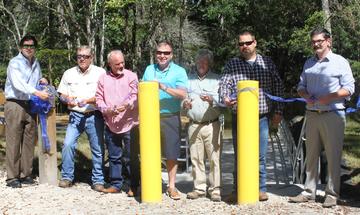
District celebrates re-opening of Cotton Landing

Cotton Landing Ribbon Cutting large

VERNON – The Northwest Florida Water Management District celebrated Wednesday the re-opening of Cotton Landing, a popular recreation site just northeast of Vernon along Holmes Creek in Washington County.

Cotton Landing had been closed since January as workers restored and stabilized 125 feet of shoreline to help reduce erosion as well as provide stormwater treatment. Boardwalks and access points were also installed to prevent future impacts on water quality and habitat while also improving public access and public parking.

Governor Rick Scott, the Florida Legislature, and the Department of Environmental Protection provided $190,000 for the Cotton Landing project as part of the governor’s springs restoration funding. The District provided an additional $125,000 to complete the $315,000 project.

“Holmes Creek is an extremely popular destination for paddlers, anglers, and nature enthusiasts,” said Ted Everett, a member of the Governing Board for the Northwest Florida Water Management District. “So it was important for the District to not only take action to protect the springs along Holmes Creek but to do the work in a way that enhances the recreational opportunities for so many people who enjoy the creek. We appreciate the support from Governor Scott, the Florida Legislature, and DEP in making this restoration project a success.”

Holmes Creek is home to no fewer than 57 springs, including several second magnitude springs. The majority of flow into the creek during moderate to low flow periods originates from springs and karst features along the banks of the creek.

“Seeing the ‘before’ and ‘after’ photos of the work done at Cotton Landing shows just how important it is for us to do our part to preserve Holmes Creek and its springs,” said State Senator George Gainer, who represents Washington and Holmes counties. “Holmes Creek is a special place for so many people and this restoration work will make sure it remains a special place for years to come.”

Cotton Landing was re-opened temporarily for recreation activities during the Fourth of July weekend and the final work on the restoration project was completed two weeks ago.

“This project will protect and preserve the springs along Holmes Creek and will ensure future generations will be able to enjoy this precious natural resource for years to come,” said Representative Brad Drake, who represents Washington and Holmes counties. “The springs in northwest Florida are not just a source of great pride for our residents but they play a tremendous role in our economy and our way of life.”